Following up on the earlier discussion Searching for a unified data standard for the Bible and the idea of borrowing the Bible's Unified Scripture XML and Unified Standard Format Markers approach — I built a working version of that idea for Qur'an data, to see if it actually holds up.
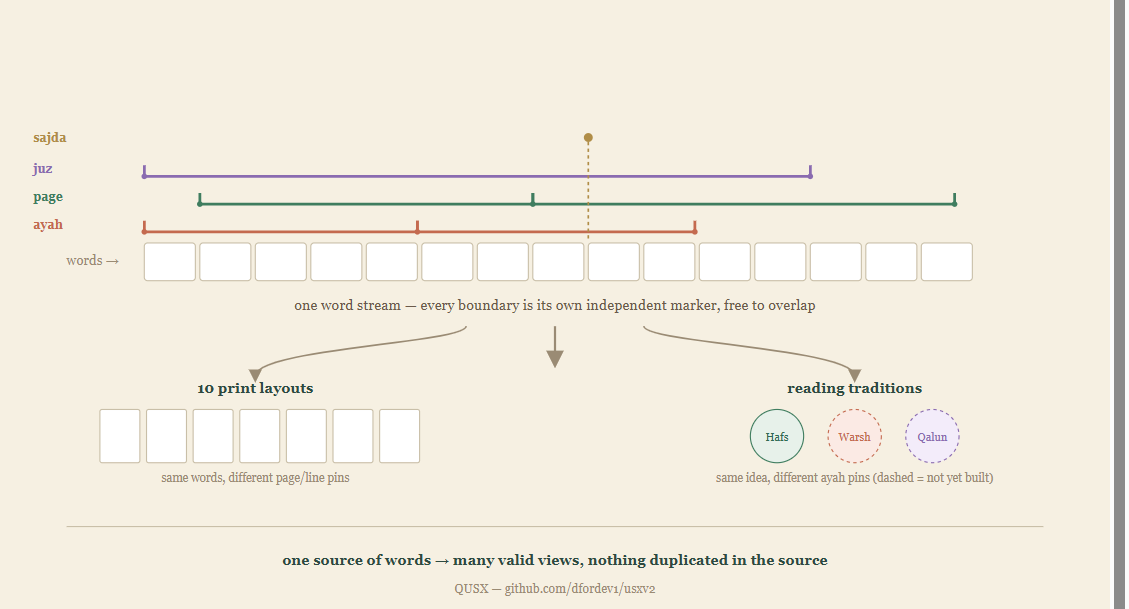
The core idea ALL CREDITS TO ORIGIONAL AUTHORS
Instead of nesting text inside verse, page, and juz containers (which breaks when a verse spans two pages, or when different counting traditions disagree), the text is a flat stream of words with open and close "pins" marking every boundary — ayah, page, juz, hizb, ruku, sajda — independently. Nothing is duplicated, and overlapping structures, such as a verse crossing a page break, are handled naturally instead of as a special case.
What has been built, not just proposed:
A generator producing real output for all 114 surahs, across 10 real Mushaf print layouts (Madani print editions 1, 2, and 4 with tajweed markings, Mushaf Qatar, five different IndoPak line-count editions, and the King Fahd Complex Nastaleeq edition) — 1140 files total, sourced from Quranic Universal Library data
A real XML Schema Definition file plus a separate semantic validator, both passing all 1140 files
A live in-browser viewer parsing real generated files with the browser's own built-in XML parser
Text integrity cross-checked against an independent SHA-256 checksum project
Continuous integration running validation and determinism checks on every change
Live demonstration: https://dfordev1.github.io/usxv2/
Source code: https://github.com/dfordev1/usxv2
Known limitation, stated plainly: the project currently supports a single reading tradition (Hafs, transmitted through Kufi script convention) only. Support for additional reading traditions (Qalun, Warsh, and others) is the natural next step, but it is blocked on finding a properly licensed source for word-level text in those traditions — if anyone in this community knows of one, that is the specific piece needed to move forward.
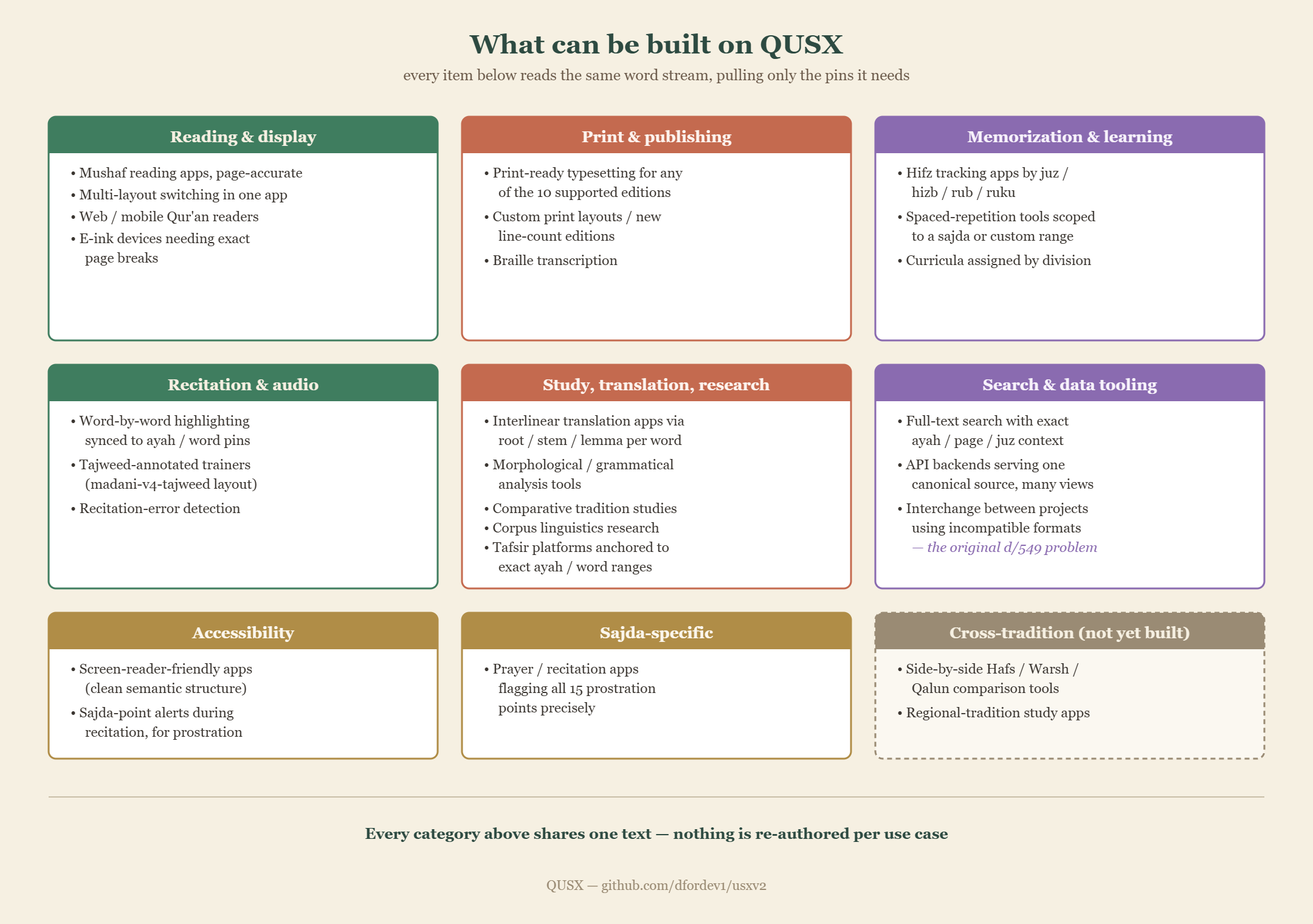
This is being shared as a concrete artifact for the discussion, not a finished proposal. Feedback on whether the milestone markup approach actually solves the problems raised in the original discussion — specifically for Qur'an data — is what is being sought.


